Bucka Roo Saves the Day!


“What’s a few tail feathers when my ladies are concerned?”


We had just come home from getting some dirt for our raised bed containers when Jessy decided to let Evee out in the dog yard.

I was in the kitchen putting away a few groceries we had picked up when I heard her scream at the dog and it was not a good scream. It was a Jessy in pure panic scream and I knew what was up… Evee had gotten out of the screen porch and was after the chickens. She is fixated on the chickens and just can’t stand it when they are too close to the house.

I fly out the door and see Jessy chasing after Evee who is chasing after a flock of chickens, with Bucka in the pack, running and flapping for the barn.

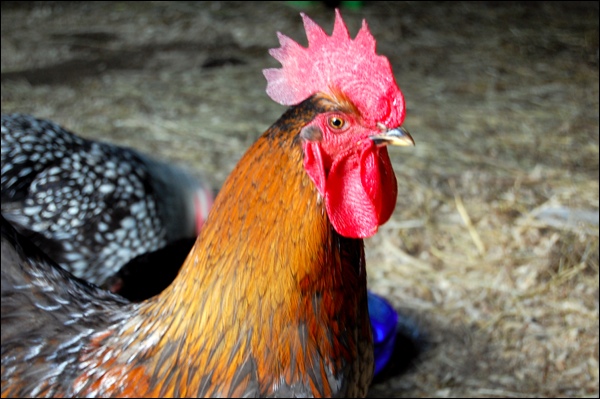
But all the sudden, Bucka gets a backbone and stops and turns to face the dog once he sees his ladies have gotten close to the barn. It was a purely unselfish act and he was ready to take on this bounding beast of terror. He got rolled by the pup, and came up fighting and managed to scare the dog pretty good, as she got a bunch of tail feathers in the skirmish as well as a face of rooster claw.

Well, she backed off pretty quick and Jessy was right there, trying so hard not to scream commands in panic, and try and sound like a good alpha owner and Evee went into her down position and stayed as Bucka rushed off towards the barn to get to his women.

Jessy caught Evee quickly, which is not normal, and actually a good sign that she’s FINALLY starting to get the whole off leash command thing, because I KNOW she wanted nothing more than to go back and chase some more chickens! And I was so proud of Jessy, because she’s still not totally cool with being too close to the chickens, but she adores them as we all do and would just be upset if her dog had hurt them.

Well Maggie had come running as well, at this point, she was out in the garden putzing and we started to look for the girls and Bucka. We found all the girls but one, in the barn, on the roost, all puffed up but calming down. We talked with them and gave them a little crack corn and just tried to show them it was okay. But we couldn’t find Mildred anywhere!!! She had been right along side of Bucka in the dash for the barn and we were concerned that she might have gotten separated from them all, and possibly hurt. And we couldn’t find Bucka!

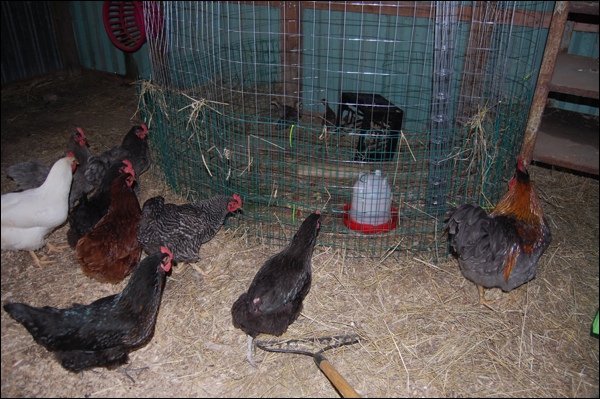
I was concerned when he didn’t come when I called him, he usually does. We fanned out, calling him and looking for signs. FInally we located him in the poultry barn! Over by the garden. He must have gotten in at the back barn that we call the pig barn, since that door was open in the back. He was walking around on the concrete shelves, all puffed up and still a little aggitated. But he looked fine from his encounter, just a little rattled. Maggie and I slowly herded him out of the long building and back to his ladies and they huddled around their protector like a war hero back from the battle! Cooing and preening him and just fussing over him like girls can do. He was very happy to be back with them.

Maggie searched for an hour and couldn’t find Mildred. Finally she gave up and came back to the house, upset, and I did my best Mom talk that she was probably just scared and hiding somewhere and to just give her a little time. She’s one of our timid hens, our beautiful little white and brown Ameracuna. Sure enough, after another hour had passed, Mildred was back with the flock. We’re not sure where she was, but I think she might have flown up into the low tree branches near the whole attack and hid out there for awhile till she thought the coast was clear.

Evee was on everyone’s list for awhile, and spent a bit of time in her crate for time out.

I realize that letting the chickens free range, has it’s drawbacks, but they love it so and we love interacting with them in our day to day routine. We also know that we can not trust the dogs to not give chase, as they have not grown up with hens or the total freedom of the farm and that we are going to have to really work on getting everyone to work together. Since we’re still not totally fenced in, we don’t let the dogs free range! Gypsy has been the only dog that I can trust around the hens, but she still eyes them with great interest, it’s just her old body doesn’t respond as her brain would like and she is very concerned about my approval and knows to curb that craving to chase. Still, I wouldn’t leave her loose in the yard because of the chance that she might hurt them.

All’s well that ends well… and it’s clear to me why a good rooster can save the day. Bucka Roo is a good boy and he got a whole quarter of a slice of pound cake for his bravery! He LOVES pound cake… haha… and I made sure that he actually got to eat it by locking up the ladies in the barn for a few minutes so he could actually enjoy his treat. Normally he looses as the ladies snatch stuff away from him without any thought to the matter. But he was a happy boy to get to enjoy his treat without bother.

And I think that maybe, just this time, the girls would have given him a chance to eat in peace. I’m sure that they all moved him up a notch in their “he’s my guy” swoon and sigh meter.

Pin It
Hillsdale Auction Report

We got up early, had a good breakfast of eggs, sausage and home made biscuits and feed the livestock, and dashed to Blue… it’s Hillsdale Livestock Auction day!!!

I had in my mind that I wanted either turkey poults, a breeding pair of banty hens or some ameracuna pullets. That was my shopping list. Oh yeah, and a pony. Of course. haha…

Well, the ponies were all outta my reach. (Hey, you never know, maybe a cranky old one for $50? It was all I had. But I was hopeful…. hahaha) I almost bought a baby goat that everyone was not bidding on. But then I thought. Why are they not bidding on it, do they know something I don’t? And I figgered that was not the goat for me. Plus we don’t really have anything fenced in good for a goat except the dog yard and I’m not sure that would be a good mix. So I passed on the goat.

So that left the poultry barn, so I went back and began to pursue the offerings. There were a LOT of roosters for some reason. But we have a lovely roo boy, and he doesn’t need any competition. I saw a few little banty pairs, one that I really considered, gold laced wyandottes… really pretty. And it was so cute how the little roo was sheltering his lady and kept cooing to her and calming her in all the scarey chaos. He was a sweet boy.

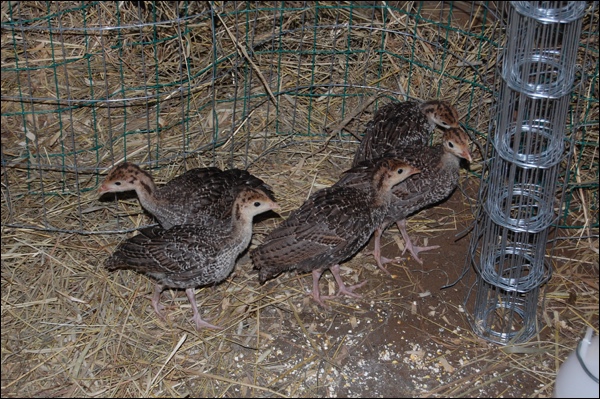
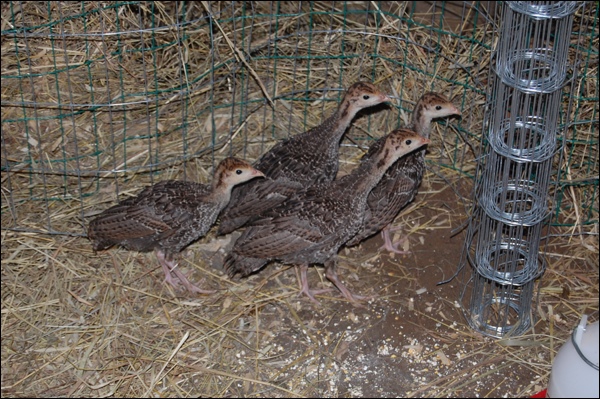
But right up front was a box of turkey poults, five of them… and I just had to get them. Just felt right. So I bid and I won them! $25 for 5! These are going to be our first meat on the claw experience and I think I got a swell deal. In the catalogs turkeys are like $10-$12 a chick! And then when I got home, I found that they are a heirloom, heritage breed called Bronze Turkeys… wow! That’s cool. They are darn cute little critters. And no, they don’t get names. They are Turkey 1 and Turkey 2 and so on. Haha… I don’t want to name food.

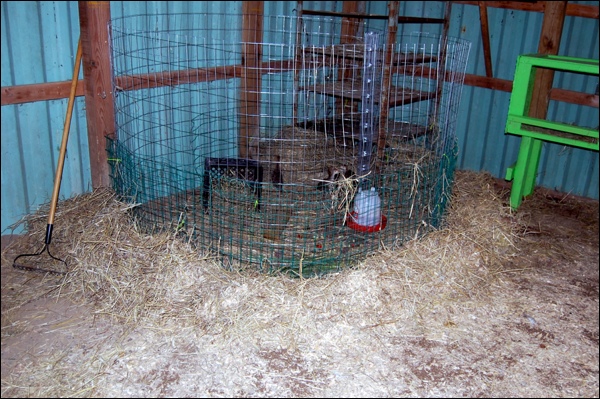
They are in for a wonderful life here at the farm! They will be free range after a day or two, I want to make sure everyone gets along and that they understand their roost home. They are feathered out, so I guess they are about 6 weeks to 2 months old. Somewhere in there. I haven’t taken any pictures of them yet, but I will. They pretty good sized, and have most of their mature feathers but their heads are still baby heads with the spots and such. I need to do a little more research into their breed, but it seems that they are on the American Livestock Conservatory list as threatened. Apparently, they can breed, unlike the commercial white broad breasted and the bronze have a superior taste. Perhaps we won’t eat them all after all! If I can get a pair to mate and go broody, we might actually raise some of these beautiful birds!

Bronze Turkey
The Bronze has been the most popular turkey variety for most of American history. It originated from crosses between the domestic turkeys brought by European colonists to the Americas and the eastern wild turkeys they found upon their arrival. The hybrid vigor of this cross resulted in turkey stocks that were larger and more vigorous than the European birds, and they were also much tamer than wild turkeys. The coppery-bronze colored metallic sheen, which gives the variety its name, was part of the inheritance from its wild ancestors.

Bronze-type turkeys were known by the late 1700s, but the name “Bronze” did not formally appear until the 1830s. Throughout the 1800s, breeders standardized the Bronze, and occasional crosses were made back to the wild turkey. The Bronze variety was recognized by the American Poultry Association in 1874.

The status of this variety has changed dramatically during the past century. In the early 1900s, a broader breasted Bronze turkey was introduced from England into Canada, and then into the northwestern United States. These were crossed with larger, faster growing US stocks and the resulting bird, the Broad Breasted Bronze, became the commercial variety of choice. Further selection improved meat production, especially that of breast meat, growth rate, and other performance qualities. At the same time, changes in conformation (especially the shortening of the legs and the keel) nearly eliminated their ability to mate naturally. For this reason, most Broad Breasted Bronze turkeys have been artificially inseminated since the 1960s. Beginning in the 1960s the Broad Breasted Bronze was replaced by the Broad Breasted White turkey. Processors favored the white-feathered variety because it produced a cleaner looking carcass. Today, the Broad Breasted Bronze is no longer used by the turkey industry, but it is promoted for seasonal, small-scale production.

Naturally mating, long-lived, slow growing strains of Bronze turkeys, known as the Standard Bronze, have been left even further behind by the turkey industry. A few tenacious breeders maintained small flocks, participating in poultry shows, and raising a few for family and friends. The Bronze was not used for commercial production for decades until the early 21st century, when renewed interest in the biological fitness, survivability, and superior flavor captured consumer interest and created a growing market niche.
The Bronze variety is stately and imposing in appearance. The standard weight for young toms is 25 pounds and for young hens is 16 pounds. Since, however, the Standard Bronze has not been selected for production attributes, including weight gain, for years, many birds may be smaller than the standard. Careful selection for good health, ability to mate naturally, and production attributes will return this variety to its former stature. Broad Breasted Bronze turkeys are also in need of conservation. Only a few hatcheries maintain breeding flocks, and many of these are reducing their number. Marketing strategies need to be developed for each type that does not undermine the other.


Well, needless to say, I’m thrilled and Maggie and I quickly made them feel at home. When I left them, they were pecking at cracked corn and a little layer mash and were drinking well. All the other birds were crowded around the little pen, watching and cackling like they were at a turkey zoo! It was pretty funny. They love anything new in the barn. Hopefully in few days we can see how they do and give them a little more freedom. I need to do a little more reading about them and make sure we give them a great live here at the farm!!!

Related Posts with ThumbnailsPin It